Prediction Markets vs. Crypto Casinos: I Compared the Expected Value
Key Takeaways
- →Polymarket spread costs 1-3% per trade; crypto casino crash games have a fixed 1% house edge
- →87% of Polymarket wallets lose money; the transparent math of provably fair games gives everyone the same odds
- →Sports betting vig (4.76% standard) is the most expensive option of the three
- →Prediction markets reward research skill; casino games reward bankroll management
- →All three platforms take your crypto and give you a shot at profit, the difference is the math
Polymarket processed over $900 million in trading volume during the week of the 2024 US presidential election alone. That single data point frames the question: prediction markets are now large enough to compare seriously against crypto sportsbooks and crypto casinos, not just treat as a curiosity. All three platforms accept crypto, settle quickly, and give you a chance to profit. The difference between them comes down to how much they take from you per dollar wagered and whether skill can change that number.
The framing most people use is wrong. They treat prediction markets as intellectual and casinos as mindless, or they treat casinos as entertainment and prediction markets as finance. Neither framing helps you figure out where your money goes furthest. A more useful frame: each platform has a cost structure, a variance profile, and a skill gradient. Mapping those three variables tells you which platform fits which type of player.

This piece walks through the exact cost structure of each platform, runs the same $1,000 bankroll through 100 bets at each edge, and gives a specific answer to who should use which product.
How Each Platform Extracts Money
Prediction Markets: The Spread
Polymarket does not charge a fee on trades. Instead, it extracts value through the bid-ask spread, the gap between what buyers will pay and what sellers will accept. On a highly liquid market like a presidential election, that spread runs 1-3 cents per share (1-3% on a $1 contract). On a thinner market, a congressional race in a safe district or a niche economic indicator, spreads of 5-10% are common.
There is also adverse selection risk that most people underestimate. When you place a market order, you are filling against someone else's limit order. If the person on the other side is a professional trader with faster information, you are the counterparty they wanted to trade with. You are not playing against a fixed edge; you are playing against the collective skill of everyone willing to take the other side of your bet.
The spread is not fixed and not visible as a single clean number. Every position you enter and exit costs you at minimum twice the half-spread (once to buy, once to sell). On a position you hold to resolution, you pay the spread once to enter and take the binary outcome at settlement. That settlement is either $1 or $0, no spread on close, but the oracle risk remains: if the resolution source is disputed, you may not get the outcome the math said you deserved.
Sports Betting: The Vig
The standard -110/-110 line at most sportsbooks means you bet $110 to win $100 on either side of the spread. The implied probability of the two sides adds up to 110/210 + 110/210 = 104.76%, not 100%. That 4.76% excess is the vig, and it is the most expensive standard cost structure of the three platforms compared here.
Books with competitive pricing (Pinnacle, some crypto books) get down to 2-3% on major NFL and NBA lines. Props are where the vig quietly climbs to 6-8% or higher. A player rushing yards over/under on a backup running back might have a 7% vig baked in, and most bettors never calculate it.
To break even at -110, you need to win 52.38% of your bets. That is the break-even rate before rake, before parlay juice, before any other fees. Most recreational bettors hit somewhere between 48% and 51% over large samples. The gap between 51% and 52.38% sounds small; at $100 per bet over 500 bets, it is the difference between a $550 loss and a $950 loss.
Parlays make the vig worse by multiplying it. A two-team parlay at -110 on each leg pays 2.6:1 at standard sportsbook odds. The true fair payout is 3:1. That gap is roughly 7.4% effective vig on the combined bet. Bettors who focus on parlays are giving up approximately 1.5x the vig of single-game bets while believing the larger potential payout means better value.
The vig is effectively a tax on every dollar you risk, paid regardless of whether you win or lose in the long run. A sharp bettor who hits 55% of -110 bets is just barely beating the vig. Most bettors do not hit 55%.
Crypto Casinos: The House Edge
Casino games publish their house edge explicitly, at least the provably fair ones. The numbers across common games:
- Crash (standard): 1%
- Blackjack (basic strategy): 0.5%
- European Roulette: 2.7%
- American Roulette: 5.26%
- Slots: 2-10% depending on the game and casino
The key difference from the other two platforms is verifiability. A provably fair crash game lets you confirm, using the published hash and server seed, that the result was predetermined before you bet and that the algorithm matches the claimed house edge. You can use the provably fair verifier to run this check on any completed round. No sportsbook and no prediction market offers equivalent mathematical transparency.
The house edge in a casino game is also stable. It does not widen when markets are thin, and you are not disadvantaged relative to other participants. Every player at a crash game faces the same 1% edge regardless of how much money they bring or how sophisticated they are.
How $100 moves through each platform
Polymarket (liquid market)
Sportsbook (-110 line)
Crash game (1% edge)
The EV Comparison Table
Expected value comparison across platform types
| Metric | Polymarket | Sports Betting | Crash Game | Blackjack | Roulette |
|---|---|---|---|---|---|
| Cost per $100 wagered | $1-3 (spread) | $4.76 (vig) | $1.00 (edge) | $0.50 (edge) | $2.70 (edge) |
| Can skill improve EV? | Yes (research) | Yes (handicapping) | No | Yes (strategy) | No |
| Speed per round | Days to weeks | Minutes | Seconds | Minutes | Seconds |
| Provably fair | N/A (oracle) | No | Yes (verifiable) | Depends | Depends |
| KYC required | No (Polymarket) | Usually yes | Usually no | Usually no | Usually no |
| Crypto native | Yes (USDC) | Rarely | Yes | Yes | Yes |
| Payout speed | Minutes | Hours to days | Minutes | Minutes | Minutes |
The table makes one thing clear that most comparisons miss: a crypto crash game at 1% edge is cheaper per dollar wagered than Polymarket on any but its most liquid markets. If you are trading a market with a 3% spread, you are giving up three times the edge of a well-structured crash game on every round trip. That is not a knock on Polymarket specifically; it is just the math of thin order books.
The "speed per round" row has real financial implications. Prediction markets resolve over days or weeks. This limits how much volume you can push through them in a given time period, which caps your total expected loss even when the per-trade cost is higher than a casino. If you have a 2% effective spread on Polymarket and you make five trades a week at $100 each, your expected weekly loss is $10. If you play crash at 1% for an hour a day, your expected daily loss might be $30-60 depending on bet size and pace. The slower cadence of prediction markets is actually a loss-limiting feature for recreational participants.
Blackjack at 0.5% edge is the cheapest option available across all five columns, assuming you play basic strategy correctly. Basic strategy is not complicated; it is a chart you can look up and memorize in an afternoon. You can use the house edge calculator to see how different rule variations (number of decks, dealer hits soft 17, surrender availability) shift the edge. Both Stake and Cloudbet offer blackjack with house rules that keep the edge near or below 0.5%.
The KYC row matters for a specific type of user: someone who wants to bet without linking their identity to gambling activity. Polymarket (on its standard interface) and most crypto casinos do not require identity verification up to certain withdrawal thresholds. Most licensed sportsbooks require full KYC before any withdrawal regardless of amount.
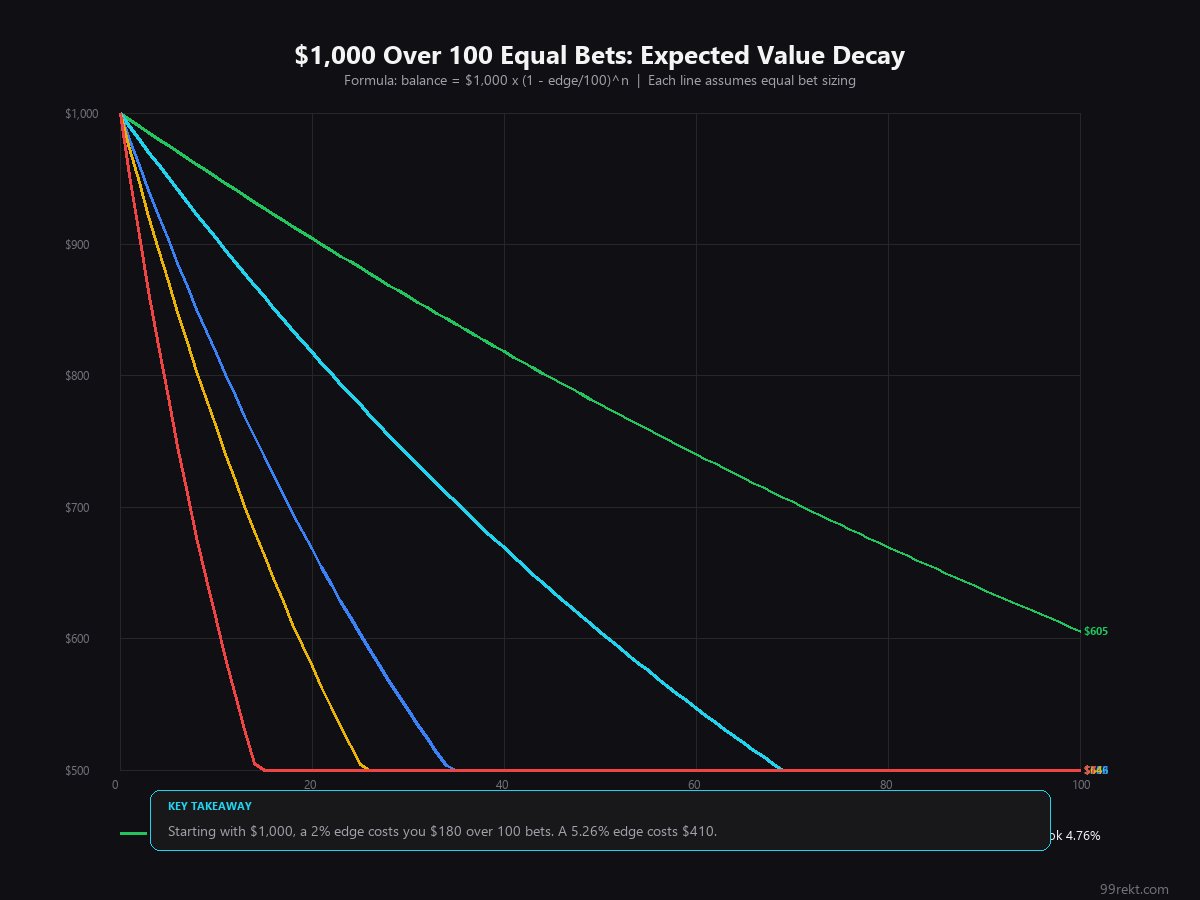
$1,000 Over 100 Bets
Expected balance: $1,000 over 100 equal bets
The chart shows what happens to a $1,000 bankroll across 100 bets of $10 each at five different edge levels. The math is straightforward: after each bet, expected balance = current balance × (1 - edge%). After 100 bets:
- Blackjack (0.5% edge): $951.11
- Crash (1% edge): $904.38
- Polymarket average (2% spread): $817.07
- European Roulette (2.7% edge): $759.40
- Sportsbook (-110 vig, 4.76% edge): $619.12
The sportsbook number is startling. After 100 $10 bets at standard lines, the expected remaining balance is about $619. That assumes you are betting randomly with no skill, but most recreational bettors are close to zero-edge. The 4.76% vig compounds aggressively over volume.
These are expected values, not guaranteed outcomes. Variance can carry any individual session far from the expected line in either direction. But over hundreds of bets, outcomes converge to the expected return. A recreational gambler putting $10,000 through a sportsbook over a year, at average -110 lines with no real edge, should expect to lose roughly $476. The same volume through a crash game costs about $100.
The speed difference matters for how quickly you accumulate volume. A crash round takes 10-30 seconds. At 100 rounds per hour, $10 per round, you are running $1,000 per hour through a 1% edge, expected loss of $10 per hour. A Polymarket position might take days or weeks to resolve. The slower pace of prediction markets naturally limits the volume you can push through them, which limits total expected loss even at a higher per-trade cost.
The variance profile also differs sharply. A $10 crash bet at 2x target is a near-coin-flip that resolves in seconds. A $100 Polymarket position on an election might have a 70/30 probability split, resolve in three weeks, and move significantly between entry and resolution based on new information. They feel like different activities because they are. One is closer to a slot machine with better odds; the other is closer to trading.
The distribution of outcomes also deserves attention beyond the simple expected value line. At 1% edge with $10 bets, your standard deviation per bet is roughly $10 (close to 100% of the bet size for a near-coin-flip game like crash at 2x). Over 100 bets, the standard deviation of your total result is approximately $10 × √100 = $100. That means roughly 68% of players end within $100 of the expected loss of $10, and about 95% end within $200. Most players playing crash at 1% edge over 100 rounds will end somewhere between $790 and $990 on a $1,000 start, not at the exact expected value of $904.
Roulette has similar variance per dollar wagered, but the higher edge pulls the center of that distribution further down. Sportsbook bettors have lower per-bet variance (a single game bet resolves roughly 50/50) but the larger edge means that over 100 bets the distribution is centered much lower. The shape of the distribution matters if you care about the probability of ending ahead on a given session. At 1% edge, you have roughly a 47% chance of ending ahead after 100 bets. At 4.76% vig, that number drops below 35%.
The Information Edge Question
The most important structural difference between prediction markets and casino games is that prediction markets allow positive expected value through superior information. If you know something the market does not, you can buy shares at a price that is wrong and profit when the market corrects or the event resolves. This is the theoretical case for prediction markets as a serious activity rather than entertainment.
The practical problem is that most people do not have a genuine information edge. Layerhub analyzed Polymarket wallet data and found that 87% of wallets that traded on the platform lost money. That is a higher loss rate than most casino games by player count. The remaining 13% who profit include both skilled researchers and people who got lucky on a small number of large positions.
The 87% figure does not mean Polymarket is a bad product. It means the information edge is concentrated. A small number of well-connected, well-researched participants extract value from a large number of casual participants who overestimate their own insight. The spread is the mechanism of transfer. When you buy into a market as an amateur, you are selling to professionals who are happy to take the other side.
For the 87% who lack a genuine edge, the comparison shifts. A 1% house edge you can verify mathematically is actually more transparent than an unknown effective edge against anonymous counterparties of unknown skill level. At least with a crash game, you know exactly what you are giving up per dollar. The 2% you pay in Polymarket spread might be going to a research firm that has already priced in the information you think is your edge.
This is not an argument that crypto casinos are better than prediction markets in any absolute sense. It is an argument that the type of person who benefits from each product is specific. If you are in the 13% with genuine research skill, Polymarket offers positive EV unavailable anywhere else. If you are in the 87%, you are better served by a game with a known, low, verifiable edge. The crash game math guide explains exactly why no strategy can beat a fixed edge over time, which is actually reassuring: the game is fair, just negative EV.
There is also a selection bias problem in how people perceive their prediction market performance. Because positions take days or weeks to resolve, and because winners tend to talk about their wins more than their losses, the informal evidence that surrounds prediction markets skews positive. Casino players know their session result immediately. Prediction market participants can go weeks feeling like they are making good calls while their portfolio quietly deteriorates. The 87% loss figure from Layerhub controls for this: it looks at actual wallet balances over time, not self-reported outcomes.
The oracle risk in prediction markets is worth naming explicitly. Casino games resolve automatically by algorithm. Prediction markets resolve by human or oracle judgment. The 2024 US election resolved cleanly on Polymarket. Other markets have had disputed resolutions, slow resolutions, or resolutions that did not match what traders expected based on the literal contract language. That risk has no equivalent in a provably fair casino game. The algorithm either matches the hash or it does not.

Who Should Use What
The right platform depends on what you are actually good at and what you are trying to do. These are specific profiles, not a spectrum.
You follow a specific domain closely and form views before the market moves. Political junkies who work in policy, traders who track economic data releases, sports analysts who build their own models. Polymarket is the right tool. You are in the group with a real shot at the 13%. Your expected value can be positive, which is genuinely unusual. No casino game offers this.
You bet on sports regularly. At a minimum, add Kalshi or another regulated prediction market to your comparisons before placing lines. The Polymarket vs Kalshi comparison breaks down the structural differences. For a recreational bettor with no real model, switching from a standard -110 sportsbook to a tighter-lined book is worth doing before anything else. The vig difference between a 4.76% book and a 2% book is roughly $2,760 per $100,000 wagered. That is real money.
You want low-edge entertainment with mathematical transparency. Provably fair casino games are the answer. Crash at 1% edge, verified by an open algorithm, with no KYC, near-instant crypto payouts, and no counterparty skill risk. You know your expected loss rate per dollar before you start. That clarity has value.
You want the absolute lowest house edge available anywhere. Blackjack with basic strategy at Cloudbet or Stake gets the house edge to roughly 0.5%. That is lower than any prediction market spread in practice and lower than any sportsbook vig on any standard line. If your goal is to gamble with the minimum possible mathematical disadvantage, this is your answer. The skill floor is learning basic strategy, which takes a few hours. No advanced card counting required; basic strategy alone is enough to reach 0.5%.
One caveat: the 0.5% figure applies to standard single-deck or favorable multi-deck rules. Some online blackjack variants quietly add rules that raise the edge. A common one is blackjack paying 6:5 instead of 3:2, which adds about 1.4% to the house edge on its own. Always verify the rules before you sit down. The house edge calculator lets you input the specific rule set and get an accurate edge number.
You are evaluating a casino bonus. Check the bonus value calculator before committing to a wagering requirement. Bonuses at low-edge games like blackjack can be strongly positive EV if the casino allows full wagering contribution from those games. Many do not. The calculator shows you the exact expected value given the bonus size, wagering requirement, and applicable house edge. The lowest house edge casinos list filters for platforms that combine competitive edges with reasonable bonus terms.
A quick example: a $100 bonus with a 30x wagering requirement at 0.5% blackjack edge costs you $100 × 30 × 0.005 = $15 in expected edge payments to clear. You keep $85 in expected bonus value. At 2.7% roulette on the same bonus, the cost is $81, leaving $19 in expected value. That difference matters. The game you use to clear a bonus is nearly as important as the bonus terms themselves.
You are comparing multiple casinos. The casino comparison tool lets you filter by house edge, KYC policy, and withdrawal speed side by side. Those three variables cover most of what matters for a recreational player making a platform decision.

One category that does not fit neatly anywhere: people who want action on a specific outcome without doing research. A major sporting event, an election, a corporate earnings call. The honest answer is that all three platforms will take money from this person at their respective rates. Polymarket at 2-3% spread, sportsbook at 4.76%, casino at 1-2.7% depending on game. If the choice is purely recreational with no pretense of edge, the lowest-cost option is a provably fair casino game. The math does not care about the narrative.
For a deeper look at how prediction markets work mechanically, read the prediction markets explainer. If you have already decided crypto casinos are your speed, the casino comparison tool lets you filter by house edge, KYC policy, and withdrawal speed.
Last updated: March 2026. Spread and vig estimates reflect typical market conditions and vary by platform and event.
FAQ
Is Polymarket better than crypto casinos?
It depends on your skill level and goals. Polymarket can offer positive expected value if you have a genuine information edge, but 87% of wallets lose money. Crypto casino games like crash (1% house edge) and blackjack (0.5% house edge) have fixed, transparent costs that are lower per bet than the typical Polymarket spread on thin markets.
What is the house edge on Polymarket?
Polymarket does not have a traditional house edge. Instead, it has a bid-ask spread that functions like one. On liquid political markets, this spread is typically 1-3%. On thin or niche markets, it can be 5-10%. You also face adverse selection risk from trading against better-informed participants.
How does prediction market expected value compare to casino expected value?
Per $100 wagered, Polymarket costs $1-3 in spread, sportsbooks cost $4.76 in vig, crash games cost $1 in house edge, blackjack costs $0.50, and roulette costs $2.70. Casino edges are fixed and verifiable. Prediction market costs vary by market liquidity and your skill level.
Can you use crypto on prediction markets?
Yes. Polymarket runs on USDC on the Polygon network. You deposit crypto directly to trade. Kalshi accepts both fiat (ACH, debit card) and crypto deposits. Both platforms are crypto-compatible, though Polymarket is fully crypto-native.
Is Polymarket gambling?
Polymarket functions like gambling in that you risk money on uncertain outcomes. The key difference is that prediction markets let you trade against other people (peer-to-peer), while casinos have you play against the house with a fixed mathematical edge. Regulators have not consistently classified prediction markets as gambling, though some jurisdictions treat them that way.
Last updated: March 2026