Polymarket vs Kalshi: Honest Comparison (2026)
Key Takeaways
- →Polymarket has deeper liquidity on political markets and requires no KYC
- →Kalshi is CFTC-regulated with fiat deposits (ACH, debit card) and Robinhood integration
- →Polymarket charges no trading fees; Kalshi charges fees on profits
- →Both have had controversial market resolutions
- →If you want neither and prefer transparent, fixed-odds crypto betting, provably fair casino games are a different option entirely
Polymarket has better liquidity and no KYC. Kalshi has CFTC regulation and more market types. If you are in the US and want legal certainty, use Kalshi. If you are outside the US or do not want KYC, use Polymarket. If you want neither and just want to bet with crypto at a known house edge, crypto casinos are a different option entirely.
The Full Comparison
These are the features that actually matter when choosing between the two platforms.

Polymarket vs Kalshi: detailed comparison
| Feature | Polymarket | Kalshi |
|---|---|---|
| Regulation | Unregulated (offshore) | CFTC-regulated (US) |
| KYC Required | No | Yes (ID + SSN) |
| Deposit Methods | USDC on Polygon, credit card | ACH, wire, debit card, crypto |
| Trading Fees | 0% (no fee) | Varies (fee on profit) |
| Withdrawal Speed | Minutes (crypto) | 1-3 business days (fiat) |
| Liquidity | Deep on political markets | Growing, thinner overall |
| Market Types | Politics, crypto, sports, culture | Weather, economics, politics, sports |
| Sports Markets | Yes (growing) | Yes (expanding) |
| Mobile App | Yes (iOS, Android) | Yes (iOS, Android) |
| Geographic Access | Global (except blocked countries) | US only |
| Min Trade | ~$1 | $1 |
| Max Position | No formal limit | $25,000 per contract |
| Settlement | Automatic (smart contract) | Automatic (CFTC-supervised) |
| Dispute Resolution | UMA oracle vote | CFTC oversight |
The regulatory difference is the one that shapes everything else. Kalshi fought a two-year legal battle with the CFTC to offer event contracts in the US. They won. That legal standing costs you KYC and slower withdrawals, but it also means Kalshi is not going to get shut down by a regulator tomorrow. Polymarket is available globally precisely because it does not operate under a US regulatory framework.
Two other differences stand out in daily use. The fee structure is stark: Polymarket charges nothing on trades while Kalshi takes a cut of profits. And the geographic restriction is total: Kalshi is US-only, Polymarket is everywhere except a small list of blocked countries. These two facts alone narrow the decision for most people.
Where Polymarket Wins
Liquidity
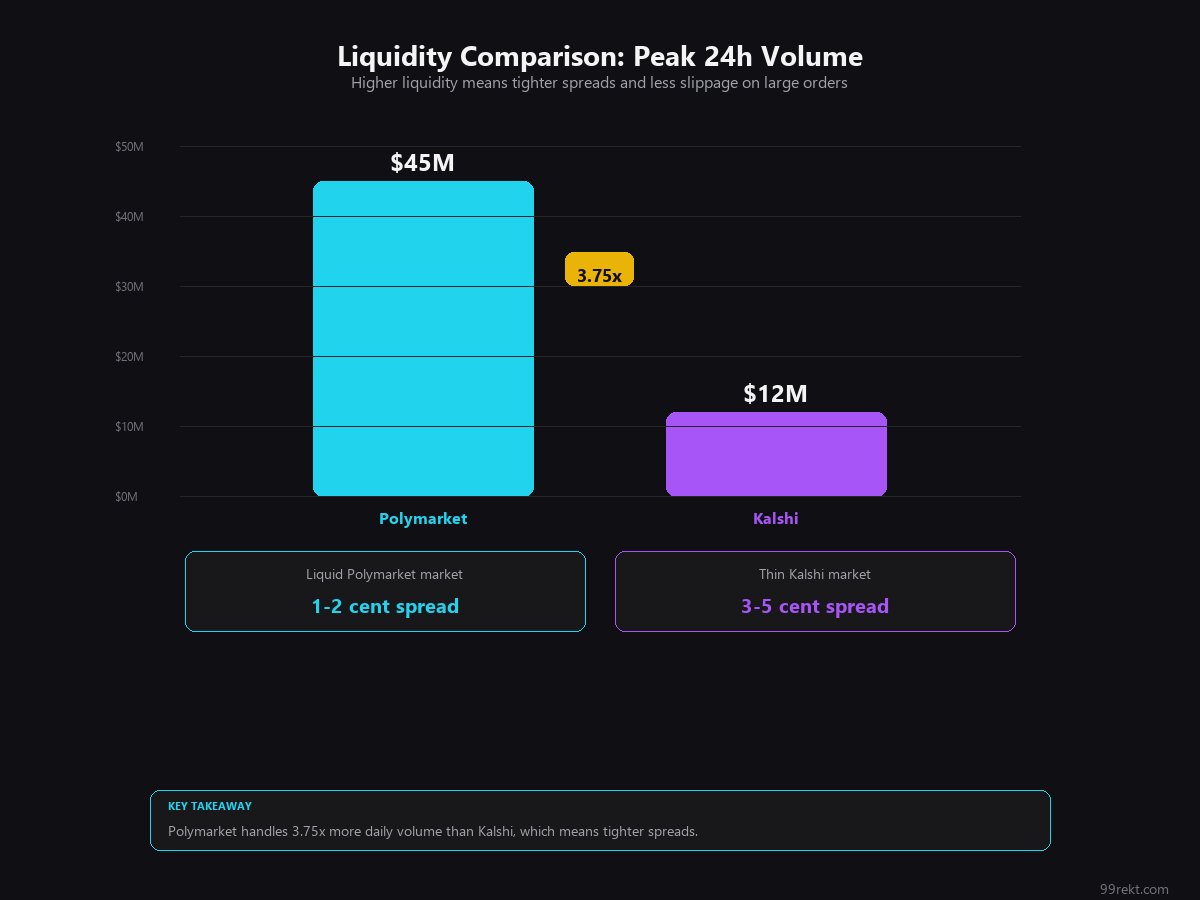
On major political markets, Polymarket is not close. During the 2024 US presidential election cycle, Polymarket routinely had $500M to $1B+ in open interest on a single market. Kalshi's equivalent markets had a fraction of that depth. This matters in practice: tighter spreads, less slippage on large positions, and a more accurate price signal.
Typical 24h volume on US election markets (example)
The liquidity gap is not universal. Kalshi has been catching up on economics-focused markets (Fed rate decisions, CPI, jobs reports) where institutional traders prefer the regulated environment. But for high-profile binary political events, Polymarket's order book is consistently deeper.
No KYC
Polymarket requires nothing to start trading. You connect a wallet, bridge USDC to Polygon, and you are in. No passport scan, no SSN, no proof of address. For users outside the US or users who simply do not want to hand their identity to a prediction market startup, this is not a small point.
The practical implication is that Polymarket's user base includes a larger share of anonymous traders, which can affect market dynamics. Anonymous markets tend to have more aggressive information traders, since there is no identity accountability. That cuts both ways: deeper information aggregation, but also more adverse selection if you are trading without an edge.
No Trading Fees
Polymarket takes no fee on trades. The market maker/taker spread is the only transaction cost. Kalshi charges a fee on profits, which varies by market type and position size. On a winning $1,000 bet, Kalshi's fee could be $10 to $20+ depending on the specific market. Over many trades, this compounds against you.
There is also a small gas cost on Polygon for each Polymarket trade, but at typical Polygon fees this is fractions of a cent, not worth factoring into most decisions. The real cost of trading on Polymarket is the spread, which on liquid markets is tight enough to be comparable to or better than Kalshi's explicit fee structure.
Crypto-Native Infrastructure
Polymarket runs on Polygon, which means USDC deposits, smart-contract settlement, and withdrawals that clear in minutes. If the market resolves at midnight, your funds are available immediately. Fiat platforms cannot match this. ACH withdrawals from Kalshi take one to three business days.
Global Access
Polymarket is available in almost every country. Kalshi is US-only. If you are trading from the UK, Canada, Australia, or most of the world, Polymarket is your only realistic option between the two.
This is a bigger deal than it looks on paper. The 2024 US election markets on Polymarket drew traders from Europe, Asia, and South America who had no equivalent regulated venue available. That international participation is part of why Polymarket's liquidity on political markets became so deep. Kalshi's US-only stance, while legally necessary, means it permanently misses the global trader base that has contributed to Polymarket's scale.
Where Kalshi Wins
CFTC Regulation
This is Kalshi's core argument, and it is a real one. The CFTC designation means Kalshi must hold customer funds separately from operating capital, submit to audits, and maintain compliance standards. If Kalshi fails or acts in bad faith, there is a federal regulator with jurisdiction.
Polymarket has no equivalent backstop. The platform is operated from outside the US. If something goes wrong at the contract or platform level, your recourse is limited to UMA oracle disputes and whatever public pressure you can apply.
The CFTC status also matters for institutional participation. Hedge funds, prop trading firms, and other professional market participants have compliance requirements that prevent them from trading on unregulated offshore platforms. Kalshi's regulatory standing opens the door to that capital. As that capital enters, it should improve price accuracy and liquidity, especially on markets with clear economic signals like Fed decisions and jobs reports.
Fiat Deposits
Most people in the US still think in dollars. Kalshi accepts ACH transfers directly from a bank account, debit card deposits, and wire transfers. No need to buy USDC, bridge to Polygon, or understand wallet management. The onboarding path is closer to depositing at a brokerage.
For users who find crypto mechanics annoying or confusing, this matters. Polymarket's crypto-only deposit path is a barrier that is not going to disappear.
More Diverse Market Types
Kalshi offers markets on weather events, economic data releases, inflation figures, Fed decisions, and earnings outcomes. These are markets that institutional and sophisticated retail traders want, and they tend to attract serious money. Polymarket is heavily weighted toward politics and crypto prices, with a smaller catalog of economic markets.
If you want to trade whether the next CPI print comes in above 3.5% or whether the Fed cuts rates by 25 basis points at the next meeting, Kalshi's catalog is more developed.
The weather markets are particularly niche but have attracted a real user base: energy traders and agricultural businesses hedging against temperature and precipitation outcomes. This is not gambling in the recreational sense. It is a legitimate hedging use case that Kalshi's regulatory framework explicitly enables and that Polymarket is not positioned to serve at the same depth.
Robinhood Integration
In 2024, Kalshi launched through Robinhood, making prediction market contracts available to Robinhood's 20+ million users without any additional signup. This distribution advantage is meaningful. More users means more liquidity over time, assuming Kalshi can convert that access into active traders.
Tax Reporting
Kalshi issues 1099 forms for US users, the same way a brokerage does. Polymarket does not. This sounds like a minor detail until you are trying to file your taxes and reconstruct gains from on-chain transactions manually. If you want prediction market trades to flow through a simple 1099, Kalshi handles that. Polymarket requires you to track your own activity. For more on how prediction market taxes actually work, see prediction market taxes.
Where Both Fall Short
Controversial Market Resolutions
Both platforms have had resolutions that frustrated traders.
Polymarket's most notable controversy came in 2024 when UMA oracles resolved a market in a way that a significant portion of traders considered incorrect based on the plain reading of the market rules. The dispute mechanism exists, but it relies on UMA token holders voting, which introduces its own set of incentive problems. Large UMA holders can influence outcomes.
Kalshi has had resolution disputes on more nuanced markets where the outcome depended on interpretation of specific data releases. The CFTC oversight provides a backstop, but it does not eliminate ambiguity at the resolution level.
The underlying issue is that both platforms define markets with language that sounds precise but often leaves room for edge cases. If the market resolves in an edge case, you may have been right about the underlying outcome and still lose money.
Thin Liquidity on Niche Markets
Outside of the most popular markets, both platforms have the same problem: wide spreads and thin books. A $5,000 position on a niche Polymarket market can move the price meaningfully. Kalshi's smaller markets are even thinner.
Adverse selection is real here. If you are trading a niche market and you see a counterparty willing to take the other side at an attractive price, there is a non-trivial chance they know something you do not. This is especially true on markets where one side is dominated by specialists: political insiders on election markets, meteorologists on weather markets, economists on Fed decision markets.
Sports Markets Are Not Competitive
Both Polymarket and Kalshi offer sports markets. Neither offers competitive lines compared to sportsbooks. The liquidity is too thin and the market makers are not specialized sports bettors. On a major game with a straightforward line, you will get better value at a licensed sportsbook than at either prediction market. The prediction markets are interesting for unusual props or novel event structures, not for standard spreads and totals.
A concrete example: on a major NFL game, a typical sportsbook will offer -110 on each side of a spread, representing a 4.5% house take. On Polymarket or Kalshi's equivalent market, the spread between the yes and no prices on a 50/50 market often implies 5-10% in transaction costs once you account for liquidity and fees. The prediction markets are not a better deal for sports betting; they are a worse one.
The Research Burden
At a casino, you sit down and play. The house edge is published, and what you see is what you get. Prediction markets require ongoing research: understanding the resolution criteria, assessing liquidity, accounting for fees, estimating your edge versus the field, and monitoring the market for new information. That is not a knock on prediction markets, but it is a real cost that many people underestimate.
At a provably fair casino, you know the exact edge before you place the bet. You verify it with math if you want. No research required, no counterparty risk, no ambiguous resolution criteria.
What If Neither Is Right for You
Some people do not want to trade against other people. They do not want to research resolution criteria, monitor market depth, or compete against professionals with better information. They want straightforward, transparent gambling with a known edge and fast payouts.
That is provably fair crypto casinos. The house edge is published and verifiable. On a crash game with a 1% house edge, every single outcome is cryptographically verifiable before and after the fact. You are not trading against someone with a Bloomberg terminal. Settlement is instant. No counterparty, no oracle disputes, no KYC at most platforms.
You can use the comparison tool to see how different platforms stack up across house edge, game variety, withdrawal speed, and licensing. Or run your specific situation through the house edge calculator to understand what a given game actually costs you per session before you deposit.
For actual casino options with strong reputations and fast crypto withdrawals, Cloudbet and Stake are worth looking at. Cloudbet has been running since 2013 and offers deep sportsbook coverage alongside its casino. Stake is one of the highest-volume crypto casinos in operation and runs its own originals (crash, dice, mines) with published house edges and provably fair verification.
The choice between prediction markets and casinos is not really about which is better. It is about what you actually want. Prediction markets are research-intensive, peer-to-peer instruments with variable liquidity and real information value. Casinos are entertainment with a fixed edge and no skill component. If you want to use superior information to profit, prediction markets are the mechanism. If you want to gamble transparently at a known cost, provably fair casinos are cleaner.
Last updated: March 2026. Platform features change frequently. Verify current terms on Polymarket.com and Kalshi.com.
FAQ
Is Polymarket legal in the US?
Polymarket does not accept US users and blocks US IP addresses. Americans who access it via VPN do so in violation of the platform's terms of service and potentially in violation of US law. Kalshi is the legal option for US residents.

Does Polymarket have trading fees?
No. Polymarket charges no fee on trades. The cost of trading is the bid/ask spread embedded in the order book. Kalshi charges a fee on profits, which varies by market.
How does Kalshi make money if Polymarket does not charge fees?
Polymarket earns revenue through partnership arrangements and protocol-level mechanisms, though the specifics are not fully disclosed. Kalshi earns a fee on profitable trades, similar to how a broker charges commissions on winning positions. Both models are sustainable; Kalshi's is more transparent.
Which platform is safer for large positions?
For very large positions ($50K+), Kalshi's CFTC regulation and fund segregation requirements make it meaningfully safer from a custody standpoint. Polymarket's counterparty risk is smart contract risk plus platform risk with no regulatory backstop. On Kalshi, the $25,000 per contract cap is a practical limit for large positions.
Can I use both platforms?
Yes. Many traders use both. Polymarket for deep liquidity on major political markets, Kalshi for economics and regulated access. The platforms serve overlapping but distinct use cases.

How is prediction market income taxed?
In the US, prediction market gains are generally treated as ordinary income or short-term capital gains depending on the structure. Kalshi issues 1099s, which simplifies reporting. Polymarket does not, so you are responsible for tracking your own gains from on-chain data. See the full breakdown in the prediction market taxes guide.
What happens if Polymarket gets shut down?
Because Polymarket runs on smart contracts on Polygon, positions technically exist on-chain. However, the interface and resolution mechanism (UMA oracle) depend on the platform's continued operation. A shutdown during an unresolved market would be a serious problem. There is no clear precedent for how this would play out. Kalshi's CFTC status means any wind-down would be subject to regulatory oversight.
Is Kalshi's liquidity improving?
Yes, meaningfully. The Robinhood integration added distribution, and Kalshi's regulatory standing has attracted institutional market makers who will not touch Polymarket. Kalshi's liquidity on economics markets has become competitive. On pure political markets, Polymarket still leads by a wide margin, but the gap has narrowed since 2023.
FAQ
Polymarket or Kalshi: which is better?
Polymarket is better for political markets (deeper liquidity, no KYC, no trading fees). Kalshi is better for US users who want regulatory certainty (CFTC-regulated, fiat deposits, tax reporting via 1099). If you are outside the US, Polymarket is the clear choice. If you are in the US and value legal clarity, Kalshi wins.
Does Polymarket require KYC?
No. Polymarket does not require identity verification. You connect a crypto wallet and trade with USDC on Polygon. There is no identity check, no document upload, and no SSN requirement. This is one of the main reasons traders outside the US prefer Polymarket.
Does Kalshi require KYC?
Yes. Kalshi requires full KYC verification including government-issued ID and Social Security number. This is because Kalshi is regulated by the CFTC as a designated contract market. The verification process typically takes a few minutes to a few hours.
Is Polymarket legal in the US?
Polymarket operates offshore and does not block US IP addresses for most markets. However, it is not regulated in the US and previously settled with the CFTC for operating without proper registration. US users can access it, but there is regulatory risk. Kalshi is the CFTC-regulated alternative for US users who want legal certainty.
Last updated: March 2026