Crypto Casino vs Traditional Online Casino
Crypto Casino vs. Traditional Online Casino: A Genuine Comparison
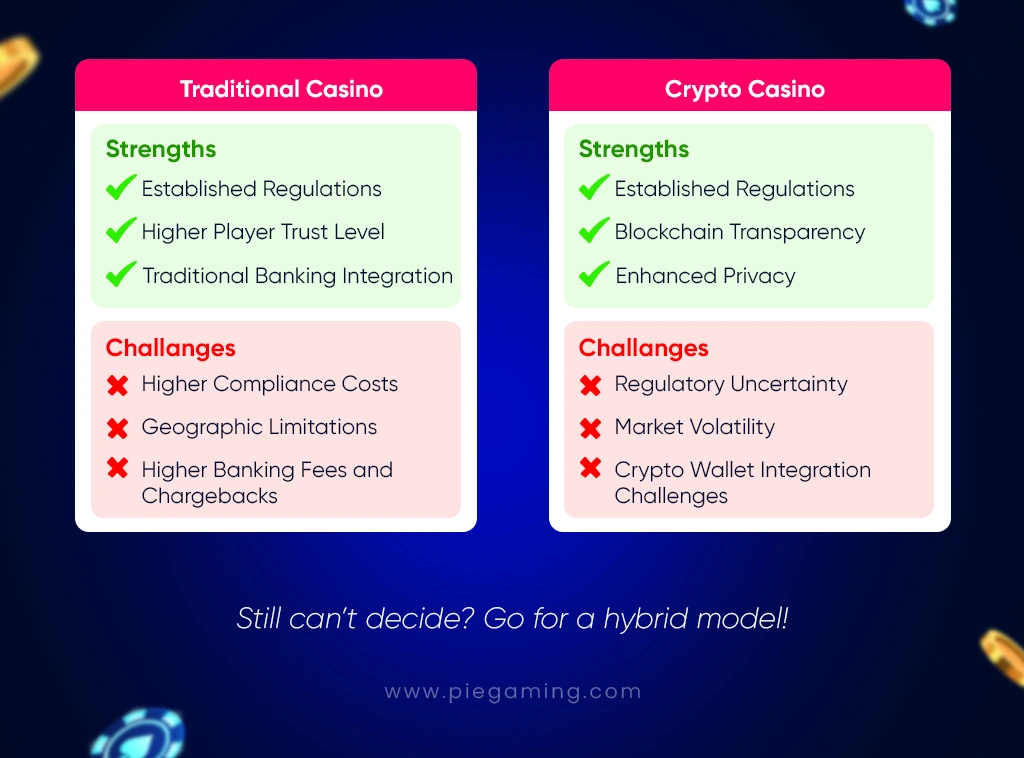
Picking between a crypto casino and a traditional online casino is not just about which one looks cooler. They work differently in ways that matter practically: how fast you get paid, how much of your personal information you hand over, what happens if something goes wrong, and what games are actually on the floor. This article breaks all of that down without sugarcoating either side.
The Speed Gap (and Why It Exists)
This is the most obvious difference, and it is real. Crypto casinos typically process withdrawals in minutes to a few hours. Bitcoin on-chain can take 20-60 minutes depending on network congestion and how many confirmations the casino requires. Lightning Network withdrawals arrive in seconds. Stablecoins on Tron or Solana? Usually under a minute.
Traditional online casinos are a different story. Bank transfers take 3-7 business days. E-wallets like Skrill or Neteller are faster at 1-3 days, but even those feel slow once you've experienced instant crypto withdrawals. And that window often assumes your account is already verified and your withdrawal has cleared their internal review. If anything triggers a manual check, add more time.
The reason for the gap is structural. When you withdraw from a traditional casino to your bank, the money moves through a chain of intermediaries: the casino's payment processor, correspondent banks, your bank's receiving queue. Each party has its own processing schedule and cut-off times. Crypto is peer-to-peer. When the casino sends funds to your wallet, there is no bank in the middle delaying things.
One important nuance: deposits are fast on both sides. The difference is almost entirely on the withdrawal end, which is the one that actually matters when you want your money.
If you want the absolute fastest option, Lightning Network deposits and withdrawals are worth understanding. See our guide on how to deposit with Lightning for the full setup.
Privacy and Identity Verification
Traditional online casinos require KYC (Know Your Customer) verification without exception. Government-issued photo ID, proof of address (utility bill or bank statement), sometimes a selfie holding your ID. This is not optional and there is no threshold below which they waive it. In most regulated jurisdictions, it is legally mandated.
Crypto casinos vary a lot here. Many let you register with just an email address and a wallet address, and you can start playing immediately. Some will only request KYC if you withdraw above a certain amount (say, 2 BTC or the equivalent), if you request a large withdrawal in a single transaction, or if their system flags something unusual. A subset offer full no-KYC experiences up to meaningful limits, particularly casinos operating under looser licensing frameworks.
The tradeoff is real and worth saying out loud: less KYC means less recourse. If a dispute arises and you never verified your identity, the casino has very little obligation to resolve it in your favor. You are also harder to locate if you want to escalate to a regulator. Privacy costs you some protection.
The regulatory landscape is also shifting. Anti-money laundering rules are tightening globally, and even crypto casinos are under increasing pressure to implement KYC. A number of mid-tier platforms that were fully anonymous three years ago now ask for verification at certain withdrawal levels. The trend is toward more verification, not less.
Transaction Fees: The Real Numbers
Fees at crypto casinos depend heavily on which network you use:
- Bitcoin on-chain: Variable. During low congestion periods, under $1. During peak periods, $10-$20 or more. The casino generally does not control this; it is the network fee.
- Lightning Network: Fractions of a cent. Effectively free for practical purposes.
- Ethereum and ERC-20 tokens: Gas fees can spike significantly. $5-$50 during high-activity periods is not unusual, which makes small transactions impractical.
- Stablecoins on Tron (TRC-20) or Solana: Usually pennies per transaction. This is why USDT on Tron has become popular at crypto casinos.
At traditional online casinos, the fee picture looks like this:
- Credit/debit cards: Often 2.5-3.5% on deposits, charged by the payment processor. Many casinos absorb this fee to stay competitive, but some pass it to the player.
- Bank wires: $15-$50 per transaction, sometimes on both ends.
- E-wallets: Usually free or low-cost for deposits, small percentage on withdrawals.
- Withdrawals: Traditional casinos sometimes charge a withdrawal fee (often $5-$10 per transaction) or make one free withdrawal per month and charge after that.
For frequent small transactions, Lightning or a low-fee stablecoin network beats everything else. For large infrequent withdrawals, the math is closer.
Provably Fair vs. Third-Party Audits
Provably fair is one of the genuinely interesting things crypto casinos introduced. The short version: before each bet, the casino commits to a cryptographic seed. After the bet resolves, you can verify mathematically that the outcome was determined by that seed and was not altered after you placed your wager. No trust required; you run the check yourself.
This only applies to in-house games (crash, dice, mines, plinko, and similar originals). Slots from third-party providers like Pragmatic Play or NetEnt use those providers' own RNG systems, which are the same whether you play them at a crypto casino or a traditional one.
Traditional casinos rely on third-party certification bodies: eCOGRA, iTech Labs, Gaming Laboratories International (GLI). These organizations audit the RNG software and publish certificates. The audits are legitimate and meaningful, but the verification model is different: you are trusting that the auditor did their job correctly and that the audited software is what is actually running. With provably fair, you verify each game result yourself.
Both approaches work. The difference is that provably fair is real-time and player-verifiable, while third-party audits are periodic and require trusting an intermediary.
For a full walkthrough of how to actually verify a provably fair result, see how provably fair works.
Regulation: Where Traditional Casinos Have a Real Advantage
This section requires honesty about what licenses actually mean in practice.
Strong licenses:
- Malta Gaming Authority (MGA): Requires segregated player funds (your money is kept separate from operating funds), has an active dispute resolution process, and enforces compliance. If a casino treats you unfairly, you have somewhere to escalate.
- UK Gambling Commission (UKGC): The strictest major license. Mandatory responsible gambling tools, transaction monitoring, self-exclusion systems. Also has teeth when it comes to enforcement.
- Gibraltar, Isle of Man: Established frameworks with real oversight. Not as comprehensive as MGA or UKGC but meaningful.
Weak licenses:
- Curacao eGaming: The most common license among crypto casinos. Annual fee around $20,000, minimal ongoing oversight, limited dispute resolution mechanisms. The license indicates the casino registered and paid; it does not indicate much about how they treat players.
- Anjouan: Even lighter touch. A more recent licensing jurisdiction that has become popular precisely because requirements are minimal.
- Costa Rica: Not technically a gambling license; casinos register as software companies. No gambling-specific oversight at all.
The practical difference: if an MGA-licensed casino refuses a legitimate withdrawal, you can file a formal complaint with the MGA and expect action. If a Curacao-licensed crypto casino does the same thing, your options are a complaint to a body with limited enforcement power, public posts, and chargebacks if you used a card (which many crypto casinos do not accept).
Some crypto casinos are now pursuing or have obtained MGA licenses in addition to their Curacao licenses. Stake holds a Curacao license and operates under regional licenses in some markets. The trend toward proper licensing is growing as the industry matures, but the majority of crypto casinos are still operating under light-touch frameworks.
For a guide on how to evaluate whether any casino is legitimate before depositing, see how to verify a casino is legit.
Bonuses and Wagering Requirements
Both casino types offer welcome bonuses, reload bonuses, cashback, and VIP programs. The headline numbers at crypto casinos often look more impressive: 200-400% match bonuses are common, sometimes with no explicit cap on the bonus amount.
Traditional casinos tend to offer 100-200% match bonuses, often capped at $200-$500.
Here is what matters more than the headline: wagering requirements.
- Crypto casinos: typically 40x-60x the bonus amount
- Traditional casinos: typically 25x-40x the bonus amount
Example comparison: $100 bonus at a crypto casino with 50x wagering means you need to wager $5,000 before you can withdraw. That same $100 bonus at a traditional casino with 30x wagering means $3,000 in wagers. The crypto casino's bigger bonus does not always translate to a better deal once you account for the higher playthrough.
One area where crypto casinos genuinely compete: rakeback and VIP programs. High-volume players at crypto casinos often receive more generous ongoing benefits than equivalent players at traditional casinos. Daily and weekly rakeback, reload bonuses that trigger automatically, and tiered VIP perks that compound over time. If you play frequently, this matters more than the welcome offer.
Game Selection
Traditional online casinos have been building libraries for longer and generally have more titles: 2,000-5,000+ games is common among established operators. Every major provider is represented: NetEnt, Microgaming, Evolution Gaming, Pragmatic Play, Play'n GO, and hundreds of smaller studios.
Crypto casinos have been catching up fast. Many now carry the same major providers, and player overlap in the slots and live dealer categories is substantial. If you want to play a Pragmatic Play slot, you can often find it at either type.
Where crypto casinos are genuinely different: original in-house games. Crash, mines, plinko, limbo, tower, and variations of these are native to the crypto casino format. You will not find them at traditional online casinos. They are typically provably fair, fast to play, and built around the kind of rapid-round gameplay that suits crypto's low-friction transaction model.
Live dealer: Both offer live dealer games. Traditional casinos often have more variety and longer-established studio relationships. The difference is narrowing.
Sports betting: Many crypto casinos include full sportsbooks under the same account: Stake, Cloudbet, and BC.Game are notable examples. Traditional online casinos sometimes offer sports betting but often operate it as a separate vertical or not at all.
Security Considerations
Traditional casinos operating under strong licenses are required to meet specific security standards: data encryption, secure fund storage, insurance requirements in some jurisdictions. Your funds sit with a regulated custodian.
Crypto casinos hold custody of your funds the same way: when you deposit, they hold the keys. The difference is that you have some ability to reduce custodial risk by withdrawing to your own wallet between sessions, something that is not possible with fiat funds at a traditional casino.
The distinction between "crypto" and "secure" is worth making explicit. The blockchain is secure, but the casino is a centralized web application. Both types of casino can be hacked. Regulatory frameworks at traditional casinos mandate security standards and may provide some recourse; crypto casinos vary widely in their security practices.
Fully decentralized smart contract casinos exist but remain niche. Most crypto casinos are centralized businesses that accept crypto, not decentralized protocols.
Global Accessibility
Traditional online casinos are frequently geo-blocked. They require banking access, and in many jurisdictions either the casino blocks local players or local banking regulations make it impossible to fund an account. Players in the US, for example, have very limited access to internationally licensed traditional casinos.
Crypto casinos are accessible from anywhere with an internet connection and a wallet. There is no bank to approve or reject the transaction. This makes them the only realistic option in many restricted markets.
VPN usage to bypass geo-blocks is common at both types but generally violates terms of service. If a casino discovers you used a VPN to register from a blocked jurisdiction, they can void your balance. The practical risk varies by casino; some are relaxed about it, others are not.
Side-by-Side Comparison
| Feature | Crypto Casino | Traditional Casino | |---|---|---| | Withdrawal Speed | Minutes to hours | 1-7 business days | | KYC Required | Often no (or delayed) | Always | | Deposit Fees | Network fees only | 0-3.5% | | Withdrawal Fees | Usually none | Sometimes $5-$10 | | Provably Fair | Yes (in-house games) | No | | Regulation Strength | Weak (typically Curacao) | Strong (MGA/UKGC) | | Game Library | Growing, 500-3,000+ | Established, 2,000-5,000+ | | Welcome Bonus | 200-400% typical | 100-200% typical | | Wagering Requirements | 40-60x | 25-40x | | Crypto-Original Games | Yes | No | | Sports Betting | Often included | Sometimes separate | | Global Accessibility | High | Restricted by banking/geo |
Which One Is Right for You?
Neither is objectively better. The right answer depends entirely on what you prioritize.
Lean toward crypto casinos if:
- Fast withdrawals matter to you (they should)
- You value privacy and want to minimize the personal data you share
- Provably fair verification appeals to you
- You want to play crash, mines, or similar originals
- You are in a jurisdiction with limited access to traditional casinos
- You plan to play at volume and want aggressive rakeback
Lean toward traditional casinos if:
- Regulatory protection is a priority (this is a legitimate reason)
- You want access to the widest possible game library
- You prefer fiat transactions and existing payment methods
- You are in a jurisdiction with access to MGA or UKGC-licensed operators and want the consumer protections that come with those licenses
One practical note: these categories are not rigid. Some crypto casinos are pursuing stronger licenses. Some traditional casinos now accept crypto deposits. The lines are blurring, and the best approach is to evaluate specific casinos rather than treating "crypto" and "traditional" as monolithic categories.
Whatever type you are evaluating, the vetting process is similar: check the license, read withdrawal terms, look for independent player reviews, and start with a small deposit before committing real money. Our guide on how to verify a casino is legit walks through exactly how to do that.
FAQ
Are crypto casinos better than regular online casinos?
It depends on priorities. Crypto casinos offer faster withdrawals (minutes vs days), more privacy (often no KYC), lower fees, and provably fair games. Traditional casinos offer stronger regulatory protections from MGA or UKGC, larger game libraries, and fiat currency convenience.
Are crypto casinos safe?
Reputable crypto casinos with verifiable licenses, provably fair games, and positive community track records are generally safe. The risk comes from weak regulation (most operate under Curacao licenses with minimal oversight) and unregulated or new platforms with no history.
Do crypto casinos have better bonuses?
Crypto casino bonuses often look larger (200-400% match vs 100-200% at traditional casinos), but wagering requirements tend to be higher (40-60x vs 25-40x). The headline number matters less than the wagering requirement. A $100 bonus at 50x means $5,000 in wagers before you can withdraw.
What games are unique to crypto casinos?
Crypto casinos offer exclusive game types you will not find at traditional casinos: crash, mines, plinko, limbo, tower, and other originals built specifically for the crypto format. These games are typically provably fair. Traditional casinos have larger libraries of slots and table games from major providers.
Last updated: March 2026